Search results for tag #ai
![[?]](https://cdn.masto.host/rustedneuroncom/accounts/avatars/000/000/001/original/6297d4b50771d4b7.png)
#bubblewatch update:
Michael Burry is comparing rising computer hardware demand in 2000 to the same today. But he's quite deliberately leaving something unsaid…
> https://substack.com/@michaeljburry/note/c-264498926
The unsaid part? The 2000 demand evaporated within months as the economy #crashed from the dotcom collapse…
#bubblewatch update:
Ed Zitron, again, points out the obvious.
> #AI Doesn't Have ROI. https://www.wheresyoured.at/ai-doesnt-have-roi/
> If you can’t measure how good something is, how much it might cost, or what your return on investment might be, it’s fair to ask why you’re even paying for it in the first place.
> … AI companies have actively conspired to mislead the world about the true costs of AI, and it was working great right up until they decided to try charging what it actually cost.
One reason #AI is a #bubble is the extent to which LLM providers and chipmakers represent effectively a third of the entire value of the stock market. They are the tail waving the whole dog.
In a healthy market one sector hitting headwinds doesn't represent a huge loss for entire indexes. But when that sector is overinflated in value – and that value can evaporate overnight *because it is inflated* – this is *exactly* what happens.
[fin]
#bubblewatch update:
Ed Zitron again with the must-reads:
> #AI Is Slowing Down. https://www.wheresyoured.at/ai-is-slowing-down/
The problem, as stated by Ed?
> AI Cannot Afford To Slow Down — It Needs $3 Trillion Or More In Revenue By End Of 2030 To Sustain Its Existence.
And yet.
> … the combined compute demand of every single AI company in the world doesn’t currently reach $100 billion …
Meanwhile.
> [There] are signs that AI’s revenue growth is slowing, and it’s likely going to slow further …
#bubblewatch update:
As SpaceX slouches it's way towards an unearned IPO, #AI stocks in general fall flat.
> Trading Day: Sizzling AI now fizzling. https://www.reuters.com/commentary/reuters-open-interest/global-markets-trading-day-graphic-2026-06-10/
> The AI frenzy is losing its luster, ironically just as the world's biggest IPO is about to land. Or perhaps they're not totally unconnected. Either way, AI and tech stocks are under pressure and are dragging the broader indices down with them.
Rip off the bandaid! Just pop the damn #bubble now!
Jeez…
#bubblewatch update:
As they near their IPOs, #AI companies must choose between increasing prices to shore up their balance sheets or losing customers as prices approach their actual costs.
It's a lose/lose situation.
> OpenAI Execs Are Panicking. https://futurism.com/artificial-intelligence/openai-execs-panicking-price-anthropic
> Put simply, the horrible economics of AI are finally starting to rear their ugly head. Astronomical capital expenditures by AI companies are starting to trickle down to users — and they’re not liking what they’re seeing.
#bubblewatch update:
Ed Zitron is, IMHO, our point man in shouting, "The #AI #bubble has no clothes!" His latest continues his high standard of debunking, this time going after the 'Mythos' 'Fable' being pushed by OpenAI.
> AI's Brokenomics. https://www.wheresyoured.at/brokenomics/
> The problem with this kind of hype is that you can only use it for so long before somebody believes you.
> … Anthropic and OpenAI have much bigger problems than regulation … Their business models don’t fucking work.
You go Ed!
#bubblewatch update:
It's good seeing this kind of thing in #newsmedia consumed by average people. It's bad seeing this kind of thing glossing over the details to the extent it becomes unconvincing in order to be consumed by average people.
> The #AI #bubble could be worse than the dot-com bust. https://thehill.com/opinion/finance/5925202-tech-bubble-ai-driven-growth/
> But with both the broader economy and the ongoing bull market relying heavily on a concentrated AI-driven boom, the fallout from a burst bubble could be severe.
#bubblewatch update:
> Consensus Grows That China Is Crushing the United States at AI. https://futurism.com/artificial-intelligence/consensus-china-crushing-usa-ai-survey
> Whether this shift in world opinion reflects growing revulsion at the American model or genuine admiration for China’s approach is hard to untangle. What’s clear is that if the US tech industry intends to keep doubling down on its extractive, worker-hostile strategy, it faces a serious legitimacy crisis far beyond what any single company can hope to solve.
#bubblewatch update:
I haven't done a market-based bubblewatch in a while, but today we are seeing a sharp drop in tech stock valuations over hyperscaler fundamentals instead of entirely unrelated Iran war news.
> Wall St tumbles on tech selloff as concerns about hawkish Fed, #AI spending mount. https://www.reuters.com/business/nasdaq-futures-fall-2-tech-worries-fed-hike-bets-2026-06-23/
> "The AI trade became one of the most crowded trades in global markets. When everybody owns the same stocks, the exit door becomes very small very quickly."
More:
Could the #SpaceX IPO be the straw that broke the #AI #bubble's back?
> Tech Stocks Are Abruptly Collapsing. https://futurism.com/space/tech-stocks-collapsing-spacex
I was quite vocal in my expectations the bubble would pop six months ago, so I'm not going out on a limb this time.
But it *is a bubble* and *bubbles eventually pop*. I just don't understand the psychology of the investor herd well enough to say what it takes to start a stampede.
#bubblewatch update:
Paul Krugman on the stock market carnage we've seen over the last few days.
> The Chips Are Down. https://paulkrugman.substack.com/p/the-chips-are-down
> There’s been a fall in tech stocks very much concentrated in semiconductors … What’s going on there? … it does seem that part of what’s happening, probably a large part of what’s happening, is that the tone, the rhetoric surrounding use of #AI, and hence the demand for compute, has really shifted quite a lot just very recently.
#bubblewatch update:
While tech stocks melt down, because investors finally started doing the math and realized it doesn't add up, Ed Zitron is still ahead of everyone else in understanding the problem. In this case he's pointing out #AI is a Cargo Cult because they've ran out of ideas and can only mimic the forms of a viable business.
> Cargo Culture. https://www.wheresyoured.at/cargo-culture/
> The AI industry is fundamentally judged based on its symbolic similarities to bygone eras.
#bubblewatch update:
Russ Mould is saying the #AI #bubble has expanded too far and will badly hurt the wider #economy when it pops. He bases this on an abnormal Shiller CAPE ratio indicating S&P 500 stocks are insanely overvalued.
> On Black Tuesday, the day that kicked off the worst financial catastrophe in modern history, the ratio was 32.5 — 8.5 points lower than it stands today.
> https://en.wikipedia.org/wiki/Cyclically_adjusted_price-to-earnings_ratio
Paywalled link:
Summary:
> https://futurism.com/future-society/impending-market-collapse-ai-bubble-stocks-overvalued
#bubblewatch update:
I boosted this separately, but I really want to encourage you to read this clear eyed discussion of the costs, demand, and pricing models for #AI
> Ways to think about token pricing. AI is in a supply crunch today, but what happens when we come out of it? How and where will supply, demand, price, capacity and capex get back into equilibrium? Today, model labs can name their price, but why won’t they end up as low-margin commodity infrastructure? https://www.ben-evans.com/benedictevans/2026/7/9/ways-to-think-about-token-pricing
#bubblewatch update:
It's important to understand the current #AI #bubble mostly consists of a small number of heavily leveraged USA-based companies pushing a business model which assumes they will still exist and will own the market in five years—at which point they hope to book profits.
There are many reasons why this is an enormous fallacy. Here is one:
> A Chinese AI Model Just Shot to Number One on the Charts, Sending Shockwaves Through the American Tech Industry. https://futurism.com/artificial-intelligence/chinese-ai-kimi-moonshot-benchmark-claude-chatgpt
#bubblewatch update:
Today's 'No Shit Sherlock' award goes to this article.
> There’s a Gigantic Problem at the Heart of the AI Industry That Could Cause the Whole Thing to Collapse. https://futurism.com/artificial-intelligence/problem-ai-industry-collapse-efficiency
> In short, as behemoth AI models are quickly becoming unaffordable to those who’ve grown to rely on them, they’re also becoming far less efficient — a concerning trajectory that could nudge the entire economy closer to the brink.
#bubblewatch update:
If you've been paying attention you know about the IOU #AI companies pass around and pretend is cash. You know about the huge amount of private debt ran up by the hyperscalers as they build out the datacenters. You know about the accelerated depreciation cycles they are trying to hide from their debtors.
Here's someone bringing all those things together:
> The NVIDIA BOOBY-TRAP? NVIDIA gets paid in cash. Someone holds the IOU. It might be you. https://substack.com/home/post/p-207653431
#bubblewatch update:
Ed Zitron does the math and concludes Hyperscaler Data Centers are the Subprime Mortgage of the #AI #bubble
> The Subprime Data Center Crisis. https://www.wheresyoured.at/the-subprime-data-center-crisis/
Remember 2008? Yeah. Like that.
Also note: The above is entirely separate from overvalued LLM companies wide open to Chinese competition running a Ponzi scheme with their stock.
🚨 🚨 #bubblewatch Red Alert! 🚨 🚨
> Investors Laying Groundwork to Profit Massively When #Economy Collapses. https://futurism.com/future-society/investors-shorting-economy
> Another glowing red indicator just lit up on the control panel steering the US economy: short sellers have placed a nearly unprecedented magnitude of bets against the domestic stock market.
> … the fact that a growing number of investors aren’t just exiting positions, but are actively betting against the US stock market is a massive tell.
#bubblewatch update:
Analysis of current outstanding investment MBS (Mortgage Backed Securities) debt showing huge losses (in the hundreds of billions) from 2022 to present.
> US might be sitting on a TIME BOMB!! https://albygetho.substack.com/p/us-might-be-sitting-on-a-time-bomb
> The greatest financial risk from the current #AI investment cycle is unlikely to come from a single company defaulting. Instead, it may emerge through a gradual deterioration in the credit chain that has developed around AI infrastructure.
#bubblewatch update:
Is the bubble already popping in Asia? Or is this just a preview?
> South Korean Authorities Scrambling to Save Stock Market From #AI #Bubble. https://futurism.com/future-society/south-korea-stock-panic-kopsi-kosdaq-circuit-breaker
> Across July 28 and 29, Seoul Economic Daily reports widespread panic triggered not just one but two “circuit breakers” on the Korea Exchange, a sort of automated kill switch that halts regular trading for 30 minutes so panic-stricken traders can gather their thoughts.
Meanwhile, over at #Amazon headquarters…
> Amazon Is Gutting Its #AI Division After Sustained Failure. https://futurism.com/artificial-intelligence/amazon-ai-division-failure-nova
> … Amazon is scaling back the ambitions of most of its Nova AI models and reorganizing its AI development teams as part of an effort to narrow its focus on “highest priority” goals, after its power-hungry large language models turned out to be a bust.
#bubblewatch update:
This is one of the signals I've been watching for!
> A Prominent AI Investor Is Now Crumbling, in What Could Be a Sign of Things to Come. https://futurism.com/artificial-intelligence/situational-awareness-ai-investor-crumbling
> Situational Awareness, a much-hyped AI hedge-fund … basically imploded over this month amid a mass tech sell-off … it’s now down 67 percent … forcing Aschenbrenner to desperately seek clients to buy its shares on the cheap to cover its losses.
See also:
#bubblewatch update:
All that borrowing by #hyperscalers building out data centers has started to distort the bond market.
> AI-driven surge in bond yields could be next risk for markets and growth. https://www.reuters.com/world/asia-pacific/ai-driven-surge-bond-yields-could-be-next-risk-markets-growth-2026-08-14/
This is bad news for everyone from home buyers to traditional businesses.
NOTE: Ed Zitron called this out weeks ago…
#bubblewatch update:
Ed Zitron's latest:
> The AI Hater's Manifesto. https://www.wheresyoured.at/the-ai-haters-manifesto/
And, yes, Ed is on 🔥!
> "Please, point to the time in history when we have invested a trillion fucking dollars in making human workers better."
> "It is genuinely hard to read anything more than puddle-deep written by AI, because the more complex a subject is, the more skilled a writer must be to convey its meaning, and the more work it must do to pull people into concepts."
[contd]
It's been a while since I did a #bubblewatch update! This is not because there haven't been economic and market news and it isn't like the Iran war isn't still clouding every issue, nor has Ed Zitron stopped ripping the #AI companies new assholes. It's just that things on the #bubble front have been kind of steady state.
But that doesn't mean people aren't worried.
> Economists Concerned the AI Bubble Is About to Blow. https://futurism.com/artificial-intelligence/economists-late-stage-ai-bubble-federal-reserve-inflation
[contd]
Finally, #AI news worth a #bubblewatch update!
> Trump’s Stargate AI Project in Huge Trouble As $18 Billion Data Center Shrivels Toward Oblivion. https://futurism.com/future-society/donal-trump-stargate-megaproject-ai-data-center-oracle-shrivels
> Early on Thursday, the AI company Oracle sent out a notice of “force majeure” to the Blue Owl Capital, the lender backing a massive hyperscale data center critical to the president’s ambitious AI project…
Invoking 'force majeure' is a big deal and we can expect big pushback. But for the bubble?
[contd]
#bubblewatch update:
The bond market has reached it's highest point since 2002. Not good news for governments with high debt loads, such as the USA and Japan. And worst news for the general #economy as borrowing costs rise across the board. But what does this have to do with the #AI bubble and #hyperscalers?
Guess where there's a surge in bond sales…
> Why are world bond markets selling off again? https://www.reuters.com/business/finance/why-are-world-bond-markets-selling-off-again-2026-10-01/
#bubblewatch update:
Related to the bond market problems described above? Analysts at Bain and Praetorian Capital have run the numbers — and they add up to bond and loan defaults for the #hyperscalers.
> Data Centers Are a $6 Trillion Time Bomb, Analysts Warn. https://futurism.com/future-society/data-centers-trillion-capital-time-bomb-bain
> “If the economics don’t work, doing it at massive scale doesn’t make the economics work any better — it just takes an industry crisis and makes it into a national economic crisis …”
Wow! Third #bubblewatch update in one day!
> One More Reason Americans Hate AI: It Does Nothing for Them. https://paulkrugman.substack.com/p/one-more-reason-americans-hate-ai
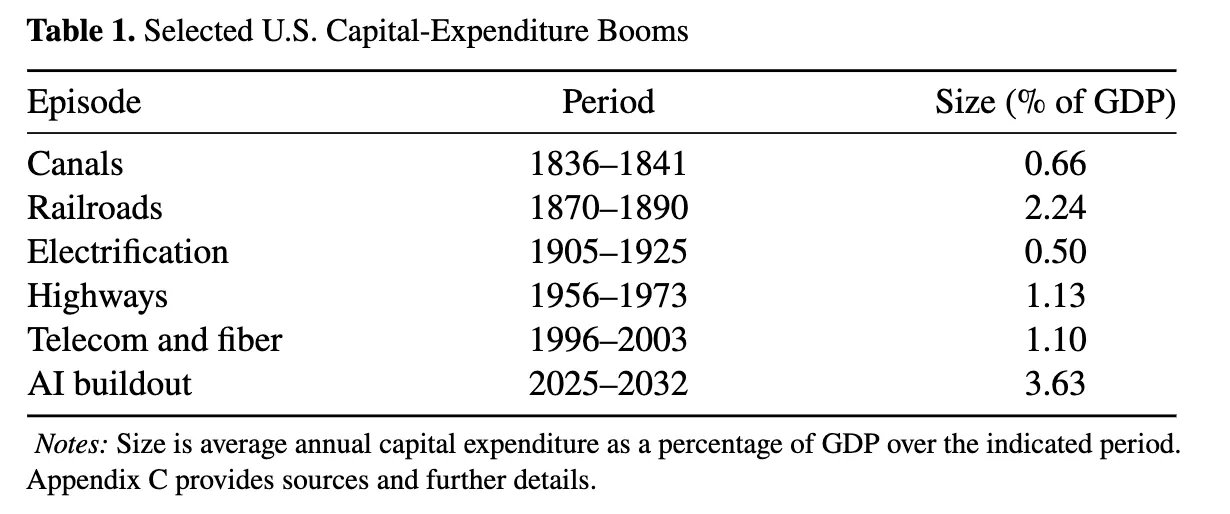
Krugman's essay is worth a read, but I'm linking to it for the attached image he swiped from elsewhere.
It's clear from this table the capex for the AI buildout is easily the biggest bet in USA history. But I think most of us can agree: It's a bad bet and likely little more than a Ponzi Scheme ripping *everyone* off.
Alt...
A table of historical USA capital expenditure booms, with the dates and percentage of GDP the capex represents, from Stijn van Nieuwerburgh.
Most of the capex booms are around 1% or less, with the two outliers being Railroads (1870-1890, 2.24%) and AI Buildout (2025-2032, 3.63%).
![[?]](https://files.mastodon.online/accounts/avatars/108/193/725/441/581/908/original/bc81fd8190f2e74c.png)
Gas-fired power stations to run new US data centers will generate as much emissions of the entire United Kingdom.
On #TechWontSaveUs, I spoke with @ketan to discuss how the data center buildout is driving a surge in fossidl fuel investment.
Listen to the full episode: https://techwontsave.us/episode/348_the_ai_buildout_is_a_boon_for_the_fossil_fuel_industry_w_ketan_joshi
![[?]](https://mastodon.laurenweinstein.org/system/accounts/avatars/109/357/023/842/046/447/original/aa40ce3e4660a756.jpg)
Noticing some financial institutions sending out emails to customers advising them not to connect #AI agents to their accounts, warning them that the customers will likely end up responsible for all the horrible mistakes the AI agents make. Which is a completely accurate assertion.
 boosted
![[?]](https://media2.ai6yr.org/accounts/avatars/109/321/592/360/914/018/original/f918064fa4350d36.jpg)
WSJ: Inside Google’s AI Push Into Schools: ‘It Slowed My Thinking Down’
The risks of cognitive and emotional dependence, along with falling test scores, are fueling a backlash
#ai #education #school #aipocalypse

Alt...
Faced with quadratic equations, Richard Scott couldn’t resist the temptation.
The Pennsylvania eighth-grader knew that the Google search box on his school laptop was essentially an AI chatbot that would helpfully spit out answers. He started popping algebra questions into the search bar to quickly finish off his daily schoolwork.
By the end of the school year, Scott’s grades were tanking. He had started leaning on Google’s AI-assisted search for other classes, like when he needed to label the parts of a volcano or write an essay about Edgar Allan Poe’s “The Raven.” His grades in math—a subject he’d done well at previously—suffered the worst. Even though he got mostly B’s in the quarterly marking periods, according to his transcript, he failed the final.
“It slowed my thinking down,” the now-15-year-old said. “When I was in a test and I couldn’t use AI, it was hard to think.”
![[?]](https://media.tech.lgbt/accounts/avatars/112/643/673/338/194/967/original/cecc928fd2840bfc.png)
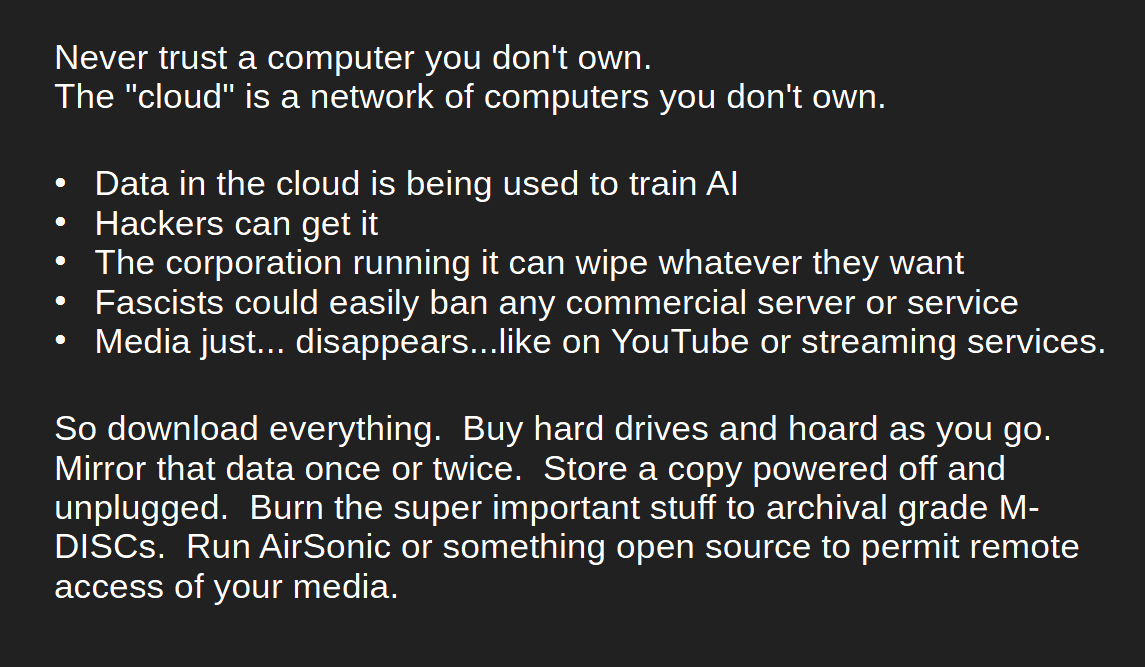
How much of YOUR data is on a computer that you do not own?
Me: None of it.
#selfhosted #selfhosting #cloud #data #security #infosec #ai
Alt...
Never trust a computer that you don't own.
The "cloud" is a network of computers you don't own.
* Data in the cloud is being used to train Al
* Hackers can get it
* The corporation running it can wipe whatever they want
* Fascists could easily ban any commercial server or service
* Media just... disappears...like on YouTube or streaming services.
So download everything. Buy hard drives and hoard as you go. Mirror that data once or twice. Store a copy powered off and unplugged. Burn the super important stuff to archival grade M- DISCs. Run AirSonic or something open source to permit remote access of your media.
![[?]](https://media.bsd.network/accounts/avatars/107/683/346/529/640/775/original/14047a412ade4150.png)
USpol, new "AI-powered" america.gov website [SENSITIVE CONTENT]
AHHAHAHAHAHAHAAHAHAH!! AHHAHAHAHAH! AHAhaahHAAHahAHaHAhaAHAHA!!!! 
OK, give me a minute to breathe or I'll pass out...
...
AHAHAhaHAaaHaaHAAHHAaAHaHAaHaAhaHAAHaAaahaHAAAAHaHAhaHAaAH....
https://www.cnn.com/2026/09/29/politics/trump-ai-website-america
Thank goodness for containerized tabs in Firefox.
#MurcaDotGov #AI #DataBrokers #PrivacyYeahRight #WhatCouldPossibleGoWrong

Alt...
Screenshot of Firefox running maximized on my MATE desktop showing a containerized tab with the america.gov AI-powered website. It says, "Hello, America" in big serif-font letters, and below that are smaller words in non-serif font saying, "Whatever you need from government, start here." Below that is a slideshow that scrolls sideways after a few seconds, but it's focused on a dude on top of the bed of his pickup truck by the edge of a river, and the search bar says, "Try "I'm a veteran. How do I get care?" There's also an attachment icon and microphone icon on the search bar. Below that are back, pause, and forward buttons for the slideshow.

Alt...
Screenshot of Firefox running maximized on my MATE desktop showing a containerized tab with the america.gov AI-powered website, scrolled a bit down where it says, "America.gov (picture of a blue circle with a white arrow inside pointing to the right that turns into the USA flag when clicked) uses AI to get simple answers only from (logos of 3 government agencies that change when you click on them in groups of three) official government sources. It's free to use, never includes ads, and keeps (picture of a finger print that performs what looks like a top-to-bottom scan of the finger print and morphs into a green check mark when clicked) your privacy protected."
If you believe that, I have a bridge I'd like to sell ya...
The america.gov search bar as described in the first image's ALT-text is at the bottom of the viewed page.
![[?]](https://files.mastodon.social/accounts/avatars/000/564/424/original/b0456e37e5ac93ad.jpeg)
#AI #KI #scam#ponzi #datacenters
'OK, so where are all these data centres? -
A construction shortfall so big you can't see it from space"
https://youtu.be/u1xH3s_zwag?si=AQoHOX_AMlJSQWIE
Here's the original article, please support #journalism!!!
https://www.ft.com/content/4c3f75a2-c2f9-4ef7-9895-21daf5e92dfe?syn-25a6b1a6=1 (€)
![[?]](https://s3.masto.ai/accounts/avatars/109/362/205/812/724/698/original/4b311491619a6f67.jpg)
When the AI slop is bad enough the AI CEO notices - YouTube
https://www.youtube.com/watch?v=2weIKnLSmIU
by @davidgerard
OpenAI hacks Australian government health data - YouTube
https://www.youtube.com/watch?v=w5dnkwAjuPs
Blog post:
https://pivot-to-ai.com/2026/09/24/openai-hacks-australian-government-health-data/
by @davidgerard
![[?]](https://media.hachyderm.io/accounts/avatars/110/492/347/627/948/632/original/e63ffdfac87c12c7.jpg)


Imagine the hell of having to get 17 mandatory certifications (my job required them)all of them covering #AI/#LLM, deep/machine learning, spec-driven #development, and the like. Now there's just one AWS cert left... I think I'm starting to fall out of love with the field.
Note: It was supposed to be ironic, but I'm terrible at that.
To be clear: I absolutely hate this new phase of the profession.
![[?]](https://kolektiva.social/system/accounts/avatars/112/182/142/067/893/534/original/8a61221b78fb01a9.jpg)
The revenue will come from us. We will pay the cost.
Billionaires will get a profit—become even richer—and they will own the systems which will supposedly make life very different.
So what do we get in return? Fewer jobs, less control over our lives, less water, more expensive electricity, a hotter, less inhabitable planet, a bigger layer of chatbots before we can reach a human, …
And our politicians are afraid "we" will lose out of we try to regulate this?
![[?]](https://files.mastodon.social/accounts/avatars/000/007/322/original/b75330fa75e75efd.jpg)
"But the students who had used A.I. more like a tutor, to explain complex concepts or clarify ideas, not only retained high test scores in the second round, but their essays were higher quality as well."
https://www.nytimes.com/interactive/2026/09/29/magazine/ai-chatbots-brain-development-study.html?unlocked_article_code=1.FFE.sb0W.xq1t00hKpgTD&smid=url-share
#AI #learning
The research behind the article,
https://arxiv.org/abs/2607.08849
https://arxiv.org/abs/2604.04721
https://arxiv.org/pdf/2605.21629v1
![[?]](https://sapka.pl/snac/michal/s/avatar-9831552a9898e1be86034c1e69219edb.jpeg)
![[?]](https://files.mastodon.social/accounts/avatars/109/245/413/456/050/702/original/dea2fe480f8be23f.png)
“ Swedish ball-bearing ad using #AI-generated film of Greta Garbo is latest case of ‘ghostsploitation’ “
https://www.theguardian.com/film/2026/sep/30/ai-greta-garbo-stars-again-ball-bearing-advert