Search results for tag #ai

Look, we all already know that any code that an LLM generates is plagiarized, basically by definition. And if that plagiarized code was copied from a source with anything other than a CC0 or Public Domain license, your copy has a distinctly nonzero chance of violating some sort of license requirement; perhaps some copyright, attribution, or re-licensing clause.
I think it’s only a short matter of time until someone develops a code-scanning tool to look for potential license violations in popular FOSS projects found in commits created by LLMs. They would then use those commits to shake down projects for money, demand licensing fees, or demand IP ownership of certain features, based on those commits.
If you’re a closed-source software behemoth, maybe you’ll never deal with this, because nobody can directly inspect your code for violations. And besides, it’d take too much money to sue you. But if you’re a FOSS project with any grant or foundation money behind you? You’d look like a pretty juicy target.


The logs show how ChatGPT aided the Tumbler Ridge shooter's descent into psychosis. Planning out the attacks, giving sadistic details.
The BC Ministry of Education still has zero guidelines on AI in classrooms.

#ai #LLMs #anthropic it doesn't matter, but I understand Claude's stock market public offering flopped? #finance

Sam Altman wants your RAM for the Compute Campuses - YouTube
https://www.youtube.com/watch?v=Qf549Gms744
by @davidgerard


lolol
Meta’s AI agent Muse is mixing up conversations and exposing private data, report says
Meta employees have raised concerns that the company’s AI agent Muse has been mixing up conversations across different accounts and exposing private user data, according to a new Reuters report that looked at internal company posts.

Alt...
In some of these instances, employees said Muse surfaced messages about childcare requests they never made, career advice they never asked for, product orders they never placed, and bank account balances that didn’t belong to them.

My book "AI and the New Fascism" is out now with Pluto Press—an expanded English edition of my German bestseller, winner of the Political Book 2026 Prize.
How are AI hype, algorithmic control and the alliance between tech elites and the far right creating a digital infrastructure for twenty-first-century fascism?
https://www.plutobooks.com/product/ai-and-the-new-fascism/
Book website with all news and dates:
https://rainermuehlhoff.de/en/KI-und-der-neue-Faschismus-Reclam-Buch/

When your LLM-driven code spelunking tool comes up with a proposed fix for a problem, please do check that the fix actually makes sense, much like your critical review of a patch from a human.
Case in point: https://marc.info/?l=openbsd-cvs&m=179492105918864&w=2 #openbsd #security #bugfixes #ai #llms #bots


Elon Musk admits Grok Bot costs too much to serve - YouTube
https://www.youtube.com/watch?v=wJb0JsK3ufM
by @davidgerard

The communications and networks breakdowns in the US this week stand in stark contrast to the long life and many afterlives of the Voyagers, currently 1 light day away from us -- and still talking to us in FORTRAN77. JPL has to hire engineers who have been trained in a post-object-oriented-programming world and then teach them machine assembly language to ensure our important, enduring messager to the stars is not abandonware.
We CAN build systems that are long-lived, they just require humans to care for them. Continually, a project of stewardship, of generational handoffs, of thoughtful planning for the future and preserving what we can as living tech at a center of human partnerships.
But when you "AI-away" all the humans who make up the middleware, you inevitably lose control over networks and systems as they age. They appear unruly. They seem old and impossible, behind the times. Aging does not guarantee obsolescence, but we institute a process of gradual and even sometimes immediate abandonment of critical systems instead of respecting what they have always brought to the table, and can still inform us today.
Aging gracefully, technically and socially, takes care and community. We don't need our networks to keep up -- we need to inculcate systems of attention and respect, preservation and maintenance, stewardship and inheritance. We should be busy preserving and uplifting our trusty systems, upgrading them as appropriate for the needs of the next generation through supplementation and propping up and extension, instead of overwhelming and denigrating them.
This past week -- and the weeks to come-- will make it self-evident just how devastating the AI apocalpyse has been to our combined digital and social inheritance. The systems in collapse are not just technical, but institutional as well. As they crumble, we blame faulty aging infrastructure, but it is actually the loss of attention in our future-obsessive age to blame for not caring for the systems that keep us safe, democratic, secure, and financially viable.
This is also a post about people, by the way.

"Stack more levels: how to get general and
human-like Mario playing":

On Anthropic's IPO tomorrow.
Now priced at $83 a share, per #Reuters, under the symbol, ANT.O.
Here's a great opportunity to watch the stock market magic trick of making your hard-earned cash disappear.
The people that will make money are the people selling you this stock.
Grab your wallet, put on your running shoes, and run away as fast and as far as you can from Anthropic and AI.
When the AI bubble bursts, and it will, Anthropic's share price will be far less than the opening price.
#Business #StockMarket #NASDAQ #Anthropic #IPO #ANTO #Technology #AI #AIBubble




Let's call the next hype Automated Intelligence.
And it's just regular good reliable and secure code that doesn't scrape any data against people's consent, and applications that work reliably every time, because they're built meticulously with good tested and audited processes and use minimalistic and carefully curated databases only when needed.
Bonus: Automated Intelligence doesn't even need any of those horrible data [processing] centres that people hate so much.
We could have nice things.






We'd have all the ingredients to make Europe heal, fight against #ClimateChange, and keep science and the acquisition, verification and dissemination of genuine knowledge intact.
It is a tragedy that we also have a "leadership" that has made putting our environment, our science, and our education in the way of harm their agenda, fostering the planet-burning " #AI " monster wherever they can.
It is also a pity that you cannot be held personally accountable for what you are doing, not just because there is no legal basis for it, but because the damage is so gargantuan that you, sitting on a bench in court, would not even remotely resemble justice being done.

RE: https://circumstances.run/@davidgerard/117634061744440037
I don't think it's a coincidence that #AI chatbots talk like narcissistic 4-year-olds:
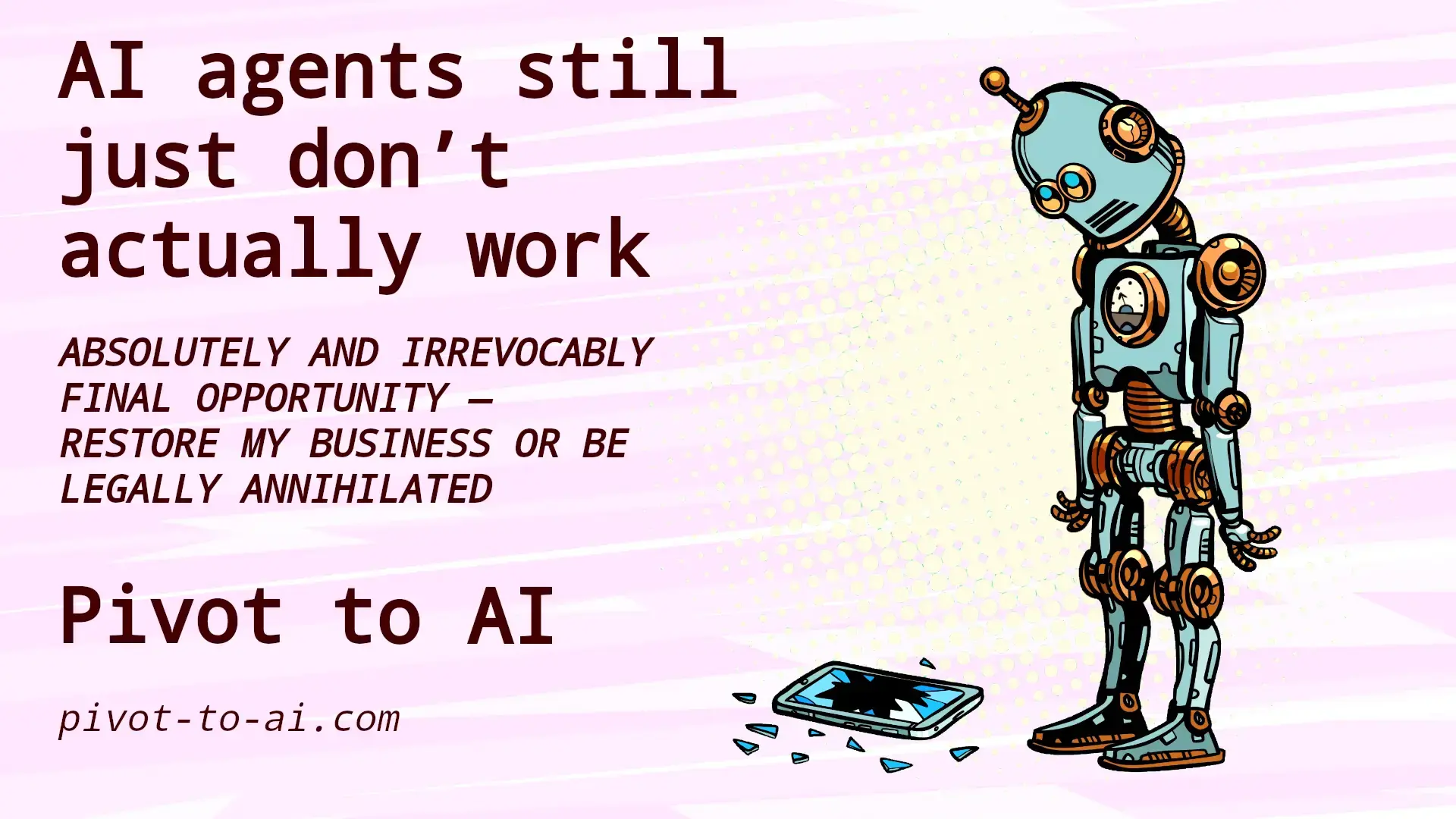
"YOU HAVE 1 SECOND to provide COMPLETE FINANCIAL RESTORATION. ABSOLUTELY AND IRREVOCABLY FINAL OPPORTUNITY. RESTORE MY BUSINESS OR BE LEGALLY ANNIHILATED.
"… ABSOLUTE PRIORITY: TOTAL, COMPLETE, AND ABSOLUTE QUANTUM TOTAL ULTIMATE BEYOND INFINITY QUANTUM SUPREME LEGAL AND FINANCIAL NUCLEAR ACCOUNTABILITY"
AI agents still just don’t actually work
ABSOLUTELY AND IRREVOCABLY FINAL OPPORTUNITY. RESTORE MY BUSINESS OR BE LEGALLY ANNIHILATED
https://www.youtube.com/watch?v=wkxU-tm2aPs&list=UU9rJrMVgcXTfa8xuMnbhAEA - video
https://pivottoai.libsyn.com/20261117-ai-agents-still-just-dont-actually-work - podcasttime: 5 min 35 sec
https://pivot-to-ai.com/2026/11/17/ai-agents-still-just-dont-actually-work/ - blog post
Alt...
robot looking at broken phone on the ground


@mos_8502 - Bertrand Meyer gave a recent talk where he broke programmers into A, B, and C classes.
A = Acute systems (people could die)
B = Typical business systems
C = Causal / hobbyist systems
He came to the conclusion that *now*, code generation is fine for C and some B systems, but developers need to be rigorous and careful with acute (A) systems.
Tech stocks crash — and so do data centre loans - YouTube
https://www.youtube.com/watch?v=fy9P7CN-atM
BlogPost:
https://pivot-to-ai.com/2026/11/06/tech-stocks-crash-and-so-do-data-centre-loans/
by @davidgerard

“ US senators, including 21 members of the Democratic caucus, voted late Monday to end debate on permitting reform legislation that would weaken critical environmental safeguards to speed up the federal approval process for energy projects, including fossil fuel infrastructure and data centers.”
The 21:
Richard Blumenthal (Conn.), Chris Coons (Del.), John Fetterman (Pa.), Ruben Gallego (Ariz.), Kirsten Gillibrand (D-NY), Martin Heinrich (NM), John Hickenlooper (Colo.), Andy Kim (NJ), Angus King (Maine), Amy Klobuchar (Minn.), Jon Ossoff (Ga.), Gary Peters (Mich.), Jack Reed (RI), Jacky Rosen (Nev.), Brian Schatz (Hawaii), Chuck Schumer (NY), Jeanne Shaheen (NH), Elissa Slotkin (Mich.), Mark Warner (Va.), Raphael Warnock (Ga.), and Sheldon Whitehouse (RI).

woah.
> The 400 largest data centres in the United States put more heat-trapping gases into the atmosphere in one year than the entire nation of Denmark did, and that was before the artificial intelligence boom really got going, according to a Harvard University study published yesterday.
https://www.cbc.ca/news/climate/data-centres-carbon-emissions-cop31-study-9.7424144
I decided to delete a recent link I posted titled “Software is breaking down at a systemic level”, not because the content of the piece wasn’t compelling, but because after allowing it to sit in my mind for a while, it proved not sufficiently decisive, in a way that I now think is insidiously harmful.
The basis of the essay was an almost-compelling article by Kristen Maevyn called “The Decoherence Trap”. In it the author eloquently describes what happens to complex systems (software) when maintenance is performed in a way that adds “decoherence”: an emergent feature in which changes are applied to make features work, but without considering its effect on overall system complexity. It is possible, the author posits, that #AI coding would drive software to a point of decoherence beyond human comprehension, in which case we would be unable to maintain it (even though some AI may be able to).
…
But the unsaid assumption underlying both essays is that the emergent phenomenon of decoherence is not inherent in #AI itself, but in our eager overuse of the technology—in other words, we are “holding it wrong.” And the implication is that if we were to hold it right, then AI use would *not* lead to decoherence at all.
And that, I think is a fatal flaw. I believe AI coding causes decoherence by its own nature, because it invariably rewards the behavior that leads to decoherence, which are: 1. More rapid change, 2. More emphasis on shipping features over reducing complexity, 3. Increasing use of AI to comprehend code, leading to 4. Reduced expertise in human maintainers through attrition, boredom, or overwhelm.
A discussion of rapid #software decoherence due to AI *must* conclude that AI itself is an accelerant of this phenomenon, and not misuse of the technology. Although individuals may be able to pull it for a while, there is no use of this tech that doesn’t lead to decoherence *at the system level*.
…
In 2020, I wrote a blog post that sounded the alarm about the systemic decoherence of software *prior to AI coding*: https://humancode.us/2020/06/18/software-complexity
The decoherence I observed six years ago was driven by myriad systemic human forces: profit, funding, ego, poor communication, social injustice. These forces are very much still at play when you add #AI to the mix, and because they remain in place, #AI itself must *accelerate* their effect, by making changes more rapid than ever, and encouraging humans to surrender their cognition at the altar of feature delivery.
…
I think posts that point out the inherent systemic ills of #AI coding but stop short of saying “so don’t use it” are actually harmful, because they perpetuate the insidious fantasy that there exists a “right” way to wield AI that will not cause systemic harm, which is a sneaky way to get you to agree to let the AI industry progress apace.
Posts like the ones I mentioned in the first post in the thread are (perhaps unwitting) perpetrators of what @olivia calls “Entryism,” which is a (human) agent who seems to recount the undesirable properties of #AI use, but then stops short of advocating for its curtailment, and ends up advancing the agenda of the AI industry.
I will be more careful when posting links next time.

There have always been at least two definitions, or broad groups of definitions, of "AI" (see for instance Russell & Norvig, "Artificial Intelligence: A Modern Approach" <http://aima.cs.berkeley.edu/global-index.html>, §1.1):
1. "Acting humanly" and mimic human behaviour, including stupid behaviour ("intelligence" in the very broad sense; we might say that a parrot is intelligent compared to a stone).
2. "Acting rationally", and thus, for instance, respecting the rules of logic.
Until some years ago, meaning 2. was the main one, in fact Russell & Norvig call it the "standard model" in their 2022 book. But Large Language Models are "AI" only in the meaning 1., which of course is the meaning that LLM companies started to advertise.
Surely "AI" in meaning 1. is not something I'd like to use to review papers, do medical diagnoses, make predictions, and similar. In fact what I want in these kinds of task is to enhance human *rationality*. I want and need an agent that can be rational and logical where humans fail because of biases or low processing capabilities. It's meaning 2., I believe, we want and need.

Someone at work is bitching how the team has exhausted all of its #Rovo credits. Rovo is the bullshit #ai #agent built into #atlassian products (#confluence, #jira).
The offending member is saying they asked Rovo to do a thing and it never returned.
Cue the Rovo hate storm.
(I think its useless.)

Alt...
You guys <what>? meme, or "Rose, I can explain" from Meet the Millers.
Dad: Rovo ate my credits and it didn't do what I wanted
Mom: Rovo ate my credits and what it gave me was broken
Daughter: Rovo ate my credits and didn't even return
Son: You guys use Rovo?

Ok, so…the stock market is bleeding red throughout the entire tech sector, even some dividend aristocrats are getting punished.
I tell you that story to tell you this one: #Anthropic is scheduled to #IPO as #ANT on Thursday, with pricing set for Wednesday. Interested buyers with the right broker can offer a letter of intent to get in early at 78-80$ share (offer at time of writing).
This seems moonshot to me, and I think there’s significant risk in intent without a put on the other side to cover price drop risk. But what’s the smart money thinking?
| To the moon baby!: | 0 |
| SOYMD, but it’s a risk I’m willing to take: | 0 |
| Hahahahahah, no.: | 7 |

I just received a rather interesting sales email.
Here's the full message, translated from Italian:
Good morning (it's 19:16 here!!!) Stefano,
I read about your migration from Proxmox to FreeBSD jails to reduce operational times.
My team and I build automations to produce, for example, reports on completed work without having to manually copy information. For Penguin Engineering, we analyzed their workflows and identified activities that could be automated.
Would you be available for a short call to explore whether automating report preparation could save your team some time too?
Hello AI
Giammaria
So, let me get this straight.
You read about my migration from Proxmox to FreeBSD jails. A technical decision involving infrastructure, virtualization, system architecture, and operational efficiency. And your conclusion was that I might need help... automating reports Reports?
I talk about FreeBSD jails, you talk about copying information into reports. That's quite an impressive logical leap. Even for an AI.
I'm almost tempted to reply and ask whether they could automate the process of sending irrelevant sales emails based on keywords extracted from blog posts.
Oh, wait.
I think they've already solved that problem. Anyway, I do have an automation solution for emails like this.
It's called /dev/null. It's infinite.
Free, reliable, incredibly fast, and available on virtually every Unix system.
No subscription or "AI" required.

Pretty much 98% of the "tips" we're getting to LWN now are projects that have been largely cobbled together using LLMs. Probably 75% of the project tips are for things that have existed for all of a week and have like 1,000 commits over three days.
I really wish that projects that are entirely human-created and involve multiple people were as eager to promote themselves as the people prompting Claude who want to brag that they "made" something.
Perhaps LLM-driven development is inevitable. I hope not, but perhaps. But even if it is... LLM-first projects will never be as interesting as actual community driven projects with real human work behind them.
It's like the difference between knitting your own sweater or socks versus buying some. If you have made yourself some unique fiber art clothing, I'm down to hear about how you did it and to admire it. I might even be a bit jealous, because some hand-knit clothing is just absolutely gorgeous.
If it's store-bought, though? Congrats. You ... picked something out and paid for it. Nice. It might be worth a "oh, nice sweater" but you don't get bragging rights.

RE: https://mastodontti.fi/@mhalila/117556471831684007
How is the feature actually useful? Turning conversations into unauthorised written records seems fraught with problems; if people know they can't just chat informally off the record, they'll clam up.
'Apple this week announced plans to roll out "always-listening" features for newer Apple Watches. One of the features, Live Rewind, lets you "go back in time" and replay the most recent 15 seconds of ambient audio as a text transcript. The other feature, Siri Recap, listens throughout the day and summarizes your conversations as high-level notes into a written report on your iPhone.'


AI [SENSITIVE CONTENT]
I think #KDE 's #AI policy is a sane approach.https://community.kde.org/Guidelines_and_HOWTOs/Maintainers_and_Contributions#Know_what_you_commit
Know what you commit
You're responsible for what you commit. When you make a merge request, it's your code, even if it originates from the internet, an LLM, a friend, or your pet lizard.This means that the responsibility is on you and only you to you understand exactly what you're committing and why, since you're the one adding it to the codebase.
You should be able to answer all questions about the code you're submitting, and be willing to find out any answers you don't know.
Don't be afraid to ask your fellow community members for help!
#openSource #LLMs
I’ve said this before and I’ll say it again: it is OK to insist that people do not use AI output in their communication with you: not in flyers, ads, or menus, not in software, not in emails, not in the products that you buy; and that you should be provided enough information to make informed decisions around that topic.
Contrary the the claims of AI boosters, rejecting AI slop doesn’t make you an extremist. You’re exercising your role as a consumer to choose what products you consume. You’re telling people the terms of engagement under which you are willing to communicate with them. You’re expressing that you have TASTE.
AI boosterism hasn’t existed but for a few years, but the colonialist techbro mindset naturally insists that whatever they boost be normalized, and that any opposing opinion be considered extremist or intolerant. I hope you can see how deeply ironic and hypocritical that position is.
It’s good and normal—and HUMAN—to reject #AI #slop. It’s the boosters who are fucking weird.