Search results for tag #books
![[?]](https://mastodon.neilzone.co.uk/system/accounts/avatars/000/000/003/original/1686a2608fa9766e.jpg)
There are other talented writers here too!
For instance, @Jaimieserotica is being published in her first book very soon.
Jaimie is a sex blogger. Reader discretion advised etc.
It is available for pre-order in both hard copy and eBook formats (but seemingly only via Amazon; sorry).
https://kinkycats.org/@Jaimieserotica/117361051980920639
Pre-orders now open for the eBook version of 'Carnal Alchemy'!!
For a mere three of your English pounds (prolly about 4 euros/dollars) you can get not only my story of sexy magic but a bunch of other stories by some proper erotica writers.
https://www.amazon.co.uk/dp/B0HLG8R156/ref=sr_1_2?crid=1LI0VUY8KC58E&dib=eyJ2IjoiMSJ9.kyqvpqVFqDDUeRaA_3fkBD2ZR-UKOSBE3HxkRpwUkrDGjHj071QN20LucGBJIEps.Fzv_vI5AwPbmLVv5x_tLLnpLmKnTvROk6JO6HRoT8ms&dib_tag=se&keywords=carnal+alchemy&qid=1790787330&sprefix=carnal+alchemy%2Caps%2C173&sr=8-2
![[?]](https://files.kinkycats.org/accounts/avatars/115/339/934/370/407/362/original/be473cef08f0144d.png)
I am eagerly awaiting @kimcrawley's new book, "Recovering After Gen AI".
This current wave of genAI hyperbole is, IMHO, a bubble which will pop in the not too distant future. Or, at least, there will be considerably more scepticism of its use than there is today.
Either way, thinking about what recovery will look like seems like time well spent.
Kim is smart, provocative, and an excellent writer.
Kim is self-publishing it, and funding it via Kickstarter, so if you fancy helping a fedi author *and* getting something topical and interesting to read very soon, perhaps pledge for a copy?
https://www.kickstarter.com/projects/kimcrawley/recovering-after-gen-ai
 boosted
![[?]](https://media.universeodon.com/accounts/avatars/109/367/296/086/291/468/original/39f59e21885a0bf5.jpg)
A Halloween sale! https://books.bookfunnel.com/halloweenienewsletter/3n21zv3gfd #books #Halloween
![[?]](https://media.hachyderm.io/accounts/avatars/109/404/940/695/763/161/original/4188ae36cff4b0fc.jpg)
Tookie Williams.
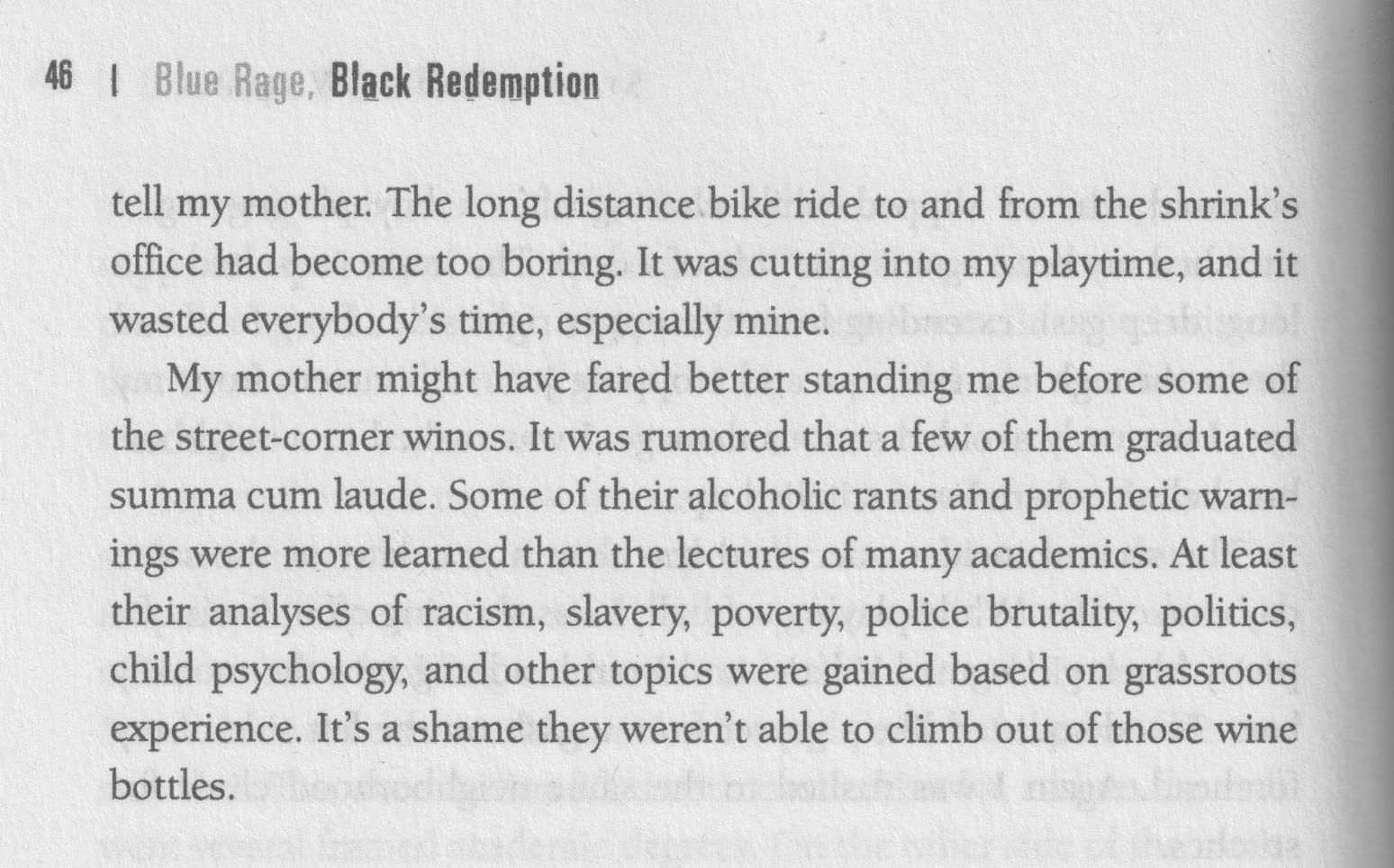
Alt...
My mother might have fared better standing me before some of
the street-corner winos. It was rumored that a few of them graduated
summa cum laude. Some of their alcoholic rants and prophetic warn-
ings were more learned than the lectures of many academics. At least
their analyses of racism, slavery, poverty, police brutality, politics,
child psychology, and other topics were gained based on grassroots
experience. It’s a shame they weren't able to climb out of those wine
bottles.
![[?]](https://files.mastodon.social/accounts/avatars/113/877/882/015/652/241/original/64d5235ebe7b9d40.png)
Nina Conti episode of Liberation Conversations is now up at patreon.com/robinince and also an excerpt from my new book The Future of Jokes
https://www.patreon.com/RobinInce/posts/liberation-bonus-171876329
#comedy #mentalhealth #books
Please sign up for regular stuff
![[?]](https://cdn.masto.host/fandomink/accounts/avatars/109/266/115/870/506/697/original/f6704317857b7302.jpg)
At the age of 58, FINALLY got around to reading some Proust. (First volume of Lost Time.)
a. Love his writing style.
b. Hate his subjects. (Ok, some of the early childhood stuff was good.)
For that time & place, I'd MUCH rather read Colette. (Goal for the next year: read some Colette in the original. My French isn't quite good enough, but it's close. Could be good enough with a little effort.)
![[?]](https://files.mastodon.green/accounts/avatars/109/296/008/158/957/265/original/fa4752072cf97c7e.jpeg)
“I think if you live long enough, you become a migrant from another timeline. There’s the world you learn to navigate as you enter adulthood, and then that world slips away from you by degrees, and after a while there’s nothing left of it, but you’re still here.”
Exit Party. Emily St. John Mandel.

Alt...
Short version: library edition audiobook cover Exit Party by Emily St. John Mandel. Fuller description: Book showing 6 hours 47 read, 5 hours 42 minutes to go. Starting "Part 2 B-side: Chapter 1'. Cover: illustrated image of an LA-style city skyline with palm trees above, then inverted below it, a Paris-style city skyline with Eiffel Tower and roofs. Merged, they resemble a Know Your Stripes graph that visualises climate-collapse temperature rises. Here, LA is blue and cool, Paris is orange and hot. Title and author name in discreet white text. Also: 'A novel', like we didn't know. And 'bestselling author of Station Eleven.'
My new book - The Future of Jokes - is out now - here is a little reading with, as ever, numerous digressions
https://www.patreon.com/RobinInce/posts/liberation-bonus-171876329
![[?]](https://files.mastodon.online/accounts/avatars/108/193/725/441/581/908/original/bc81fd8190f2e74c.png)
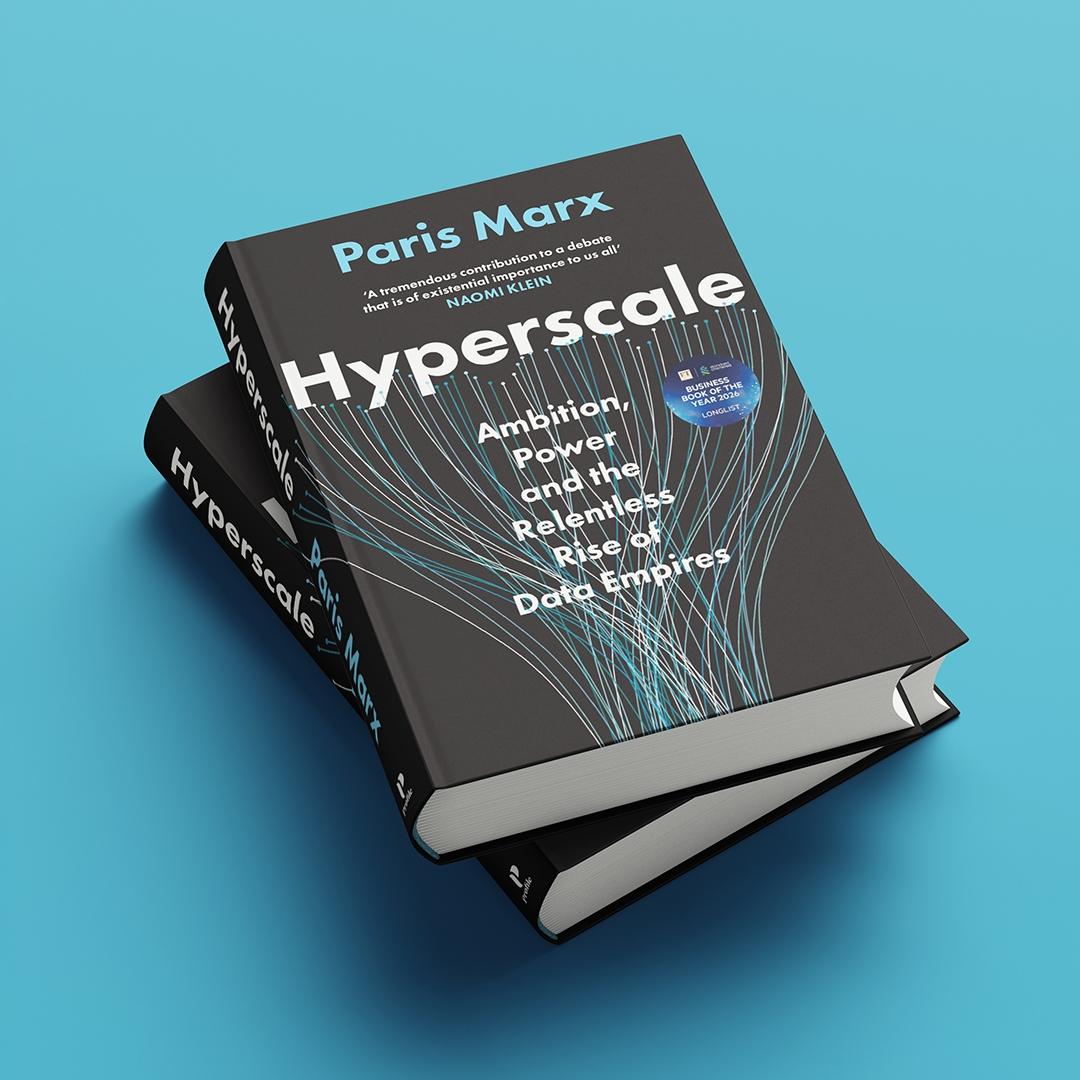
New Scientist named HYPERSCALE one of its best popular science books of October. Less than two weeks until you can get a copy of your own!
Preorder US: https://bookshop.org/a/18331/9798217048526
Preorder UK: https://uk.bookshop.org/a/10298/9781805227458
More info: https://hyperscalebook.com
#tech #techindustry #datacenters #artificialintelligence #ai #newbooks #reading #books

Alt...
The best popular-science books of October 2026
Hyperscale by Paris Marx
Forget, for a moment, grappling with AI conceptually and think about it as an environmental issue. All over the world, the data centres already built and those planned are crucial to the current AI successes and to the ambitions of the companies involved. What’s more, say the publishers of a polemical book called Hyperscale, the centres use up resources such as water and power at “dangerously unsustainable levels”. This book’s author is Paris Marx, a tech critic, journalist and host of the Tech Won’t Save You podcast. It sounds like a wild ride, with the publishers saying the “tech overlords are waging a resource war as they trade our future for their profit”. It is nothing less than a “civilisational time bomb in the making”, where tough reporting shows that “the greatest threat is not the spectre of AI, but a global disaster that has already begun”. The book is already longlisted for this year’s Financial Times Business Book of the Year award.
Alt...
UK cover of Hyperscale: Ambition, Power, and the Relentless Rise of Data Empires
![[?]](https://mastodon.tomodori.net/system/accounts/avatars/115/312/380/337/748/146/original/3d81bc18d653d64c.png)
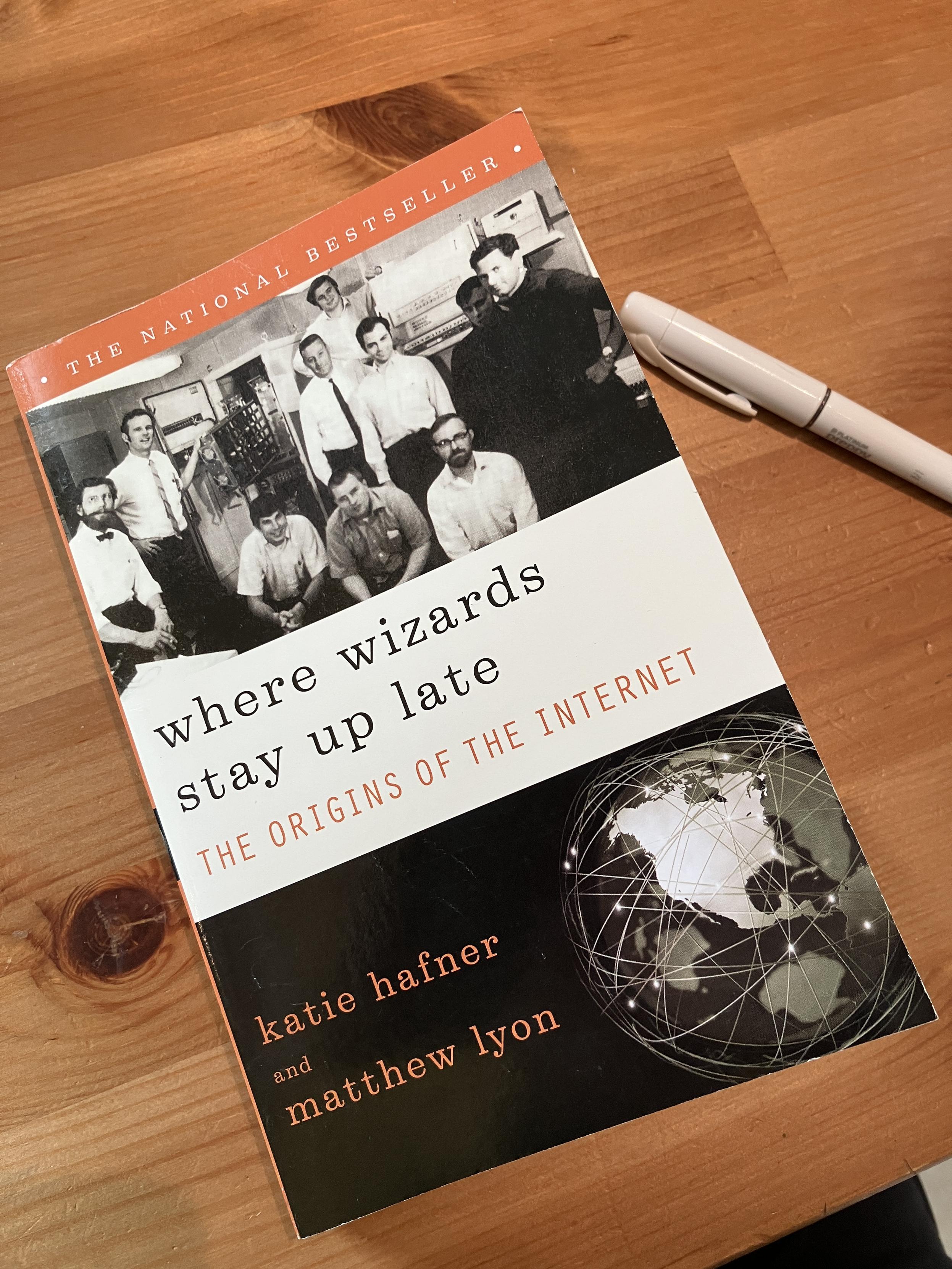
i'm genuinely surprised at how well the authors of this history of the ARPAnet strike a balance between careful technical descriptions of hardware and software, useful metaphors for understanding how they work, and the personalities behind them.
every few pages, i learn something genuinely important about computing history which had direct consequences for how i work and live today.
in the computer game history world, most people recognize Will Crowther as 'that guy who created ADVENTURE' (which directly led to the entire text adventure genre).
what no one ever talks about is that before Adventure, Crowther was a chief programmer on the ARPAnet project, and designed the dynamic routing system for packet delivery. the routing software was written entirely in incredibly tight Honeywell 516 assembly, to make intelligent decisions about how to get packets from origin to destination without using a static (deterministic) routing table
a variation of this concept went into BGP, which is the very foundation of internet routing.
it's very telling that the wikipedia entry for Crowther is almost entirely about Adventure, and has almost nothing about his major contributions to the ARPAnet.
#books #bookstodon #worldWideWeb #wikipedia
Alt...
The front cover of Where Wizards Stay up Late: The Origins of the Internet, by katie hafner and matthew lyon
![[?]](https://media.mastodon.sunny.garden/accounts/avatars/109/291/009/577/935/706/original/050ca5f97356b66d.jpg)
'They were cranes dancing on the marsh. They reached their wings out to one another, curled their necks and squawked. They started moving towards him. He sat completely still, breathing as quietly as he could. He had never seen anything so wondrous. He stared at their beaks and swaying tail feathers. Their necks moving up and down. The birds hopped about, as clumsy as newborn calves and yet the most elegant, graceful things he had ever seen.' -- from 'Tangled Roots' by Maria Turtschaninoff, trans. A.A. Prime
#WednesdayBookQuote #books #ReadingJournal #reading @bookstodon
![[?]](https://cdn.fosstodon.org/accounts/avatars/107/119/935/922/768/447/original/52adb160f5cb4520.png)
![[?]](https://stockroom.wandering.shop/accounts/avatars/109/897/938/021/639/104/original/10e7db375a6c70e8.png)
Now on #Kickstarter! Festive Fantasy Holiday Tales, fill your fall with #Christmas and #holiday #magic! https://link.rebeccasenese.com/ffht-ks2 #books #contemporaryfantasy

My new book HYPERSCALE is out in two weeks — and my copies just arrived!
I recorded an unboxing video to share some thoughts as it gets closer to release and show you what it looks like. Hate data centers? You’re going to want a copy!
Preorder yours today: https://bookshop.org/a/18331/9798217048526
#tech #ai #generativeai #datacenters #reading #books #newbooks #artificialintelligence
Bonus Lucia Osborne Crowley conversation has just gone up
https://www.patreon.com/RobinInce/posts/lucia-osborne-171424704
#podcast #books #author #activist
![[?]](https://files.mastodon.social/accounts/avatars/109/251/088/201/008/636/original/2b2bbf3940c2a31f.png)
“You have to return the #books, but you get to keep the ideas.”

Alt...
We don't sing the praises of libraries enough. One of the few places left in the world where you're allowed to exist without the expectation to spend money. You have to return the books, but you get to keep the ideas.
“For Reading Addicts”
“A tech reporter takes on an ever-expanding story: the endless proliferation of massive data centers.”
Kirkus named HYPERSCALE one of its best books to read in October. Another great signal as the release date gets closer!
Preorder your copy now: https://hyperscalebook.com
#tech #datacenters #ai #artificialintelligence #newbook #reading #books
Alt...
A timely, vigorously researched and written work of tech and advocacy journalism. — Kirkus

Alt...
Hyperscale: The Ambition and Excess of Big Tech’s Data Empires by Paris Marx. Out October 20, 2026
![[?]](https://files.mastodon.social/accounts/avatars/110/441/535/131/897/219/original/0ddf9d4dd12a5dee.png)
10 Literary Translators on the Art of Translation
"Like the ghostwriter, the translator must slip on a second skin."
by Emily Temple
Books by translators at PG:
https://www.gutenberg.org/ebooks/subjects/search/?query=translators
Alt...
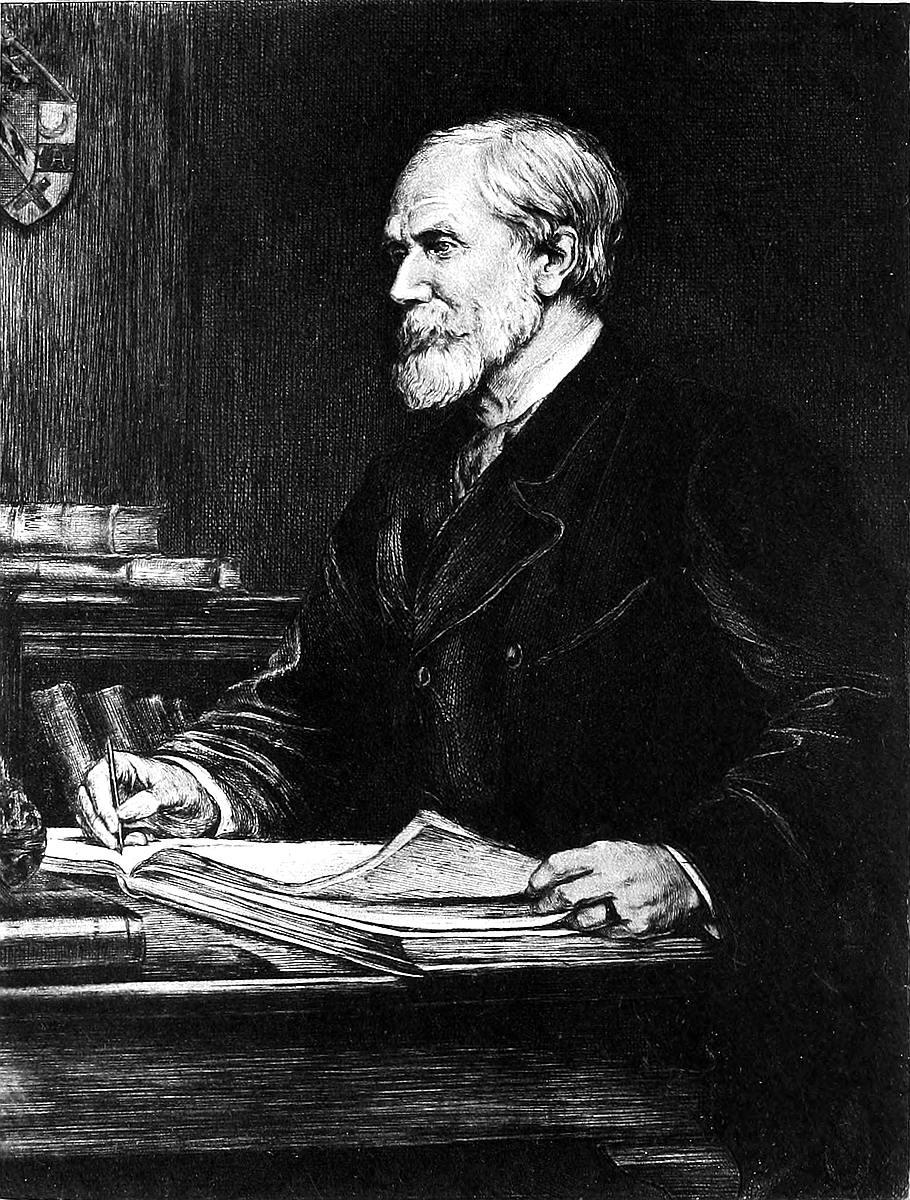
Engraved frontispiece portrait of an elderly, bearded gentleman writing at a book-covered desk, with a small coat-of-arms visible in the upper left.
Proust, 1913.
Alt...
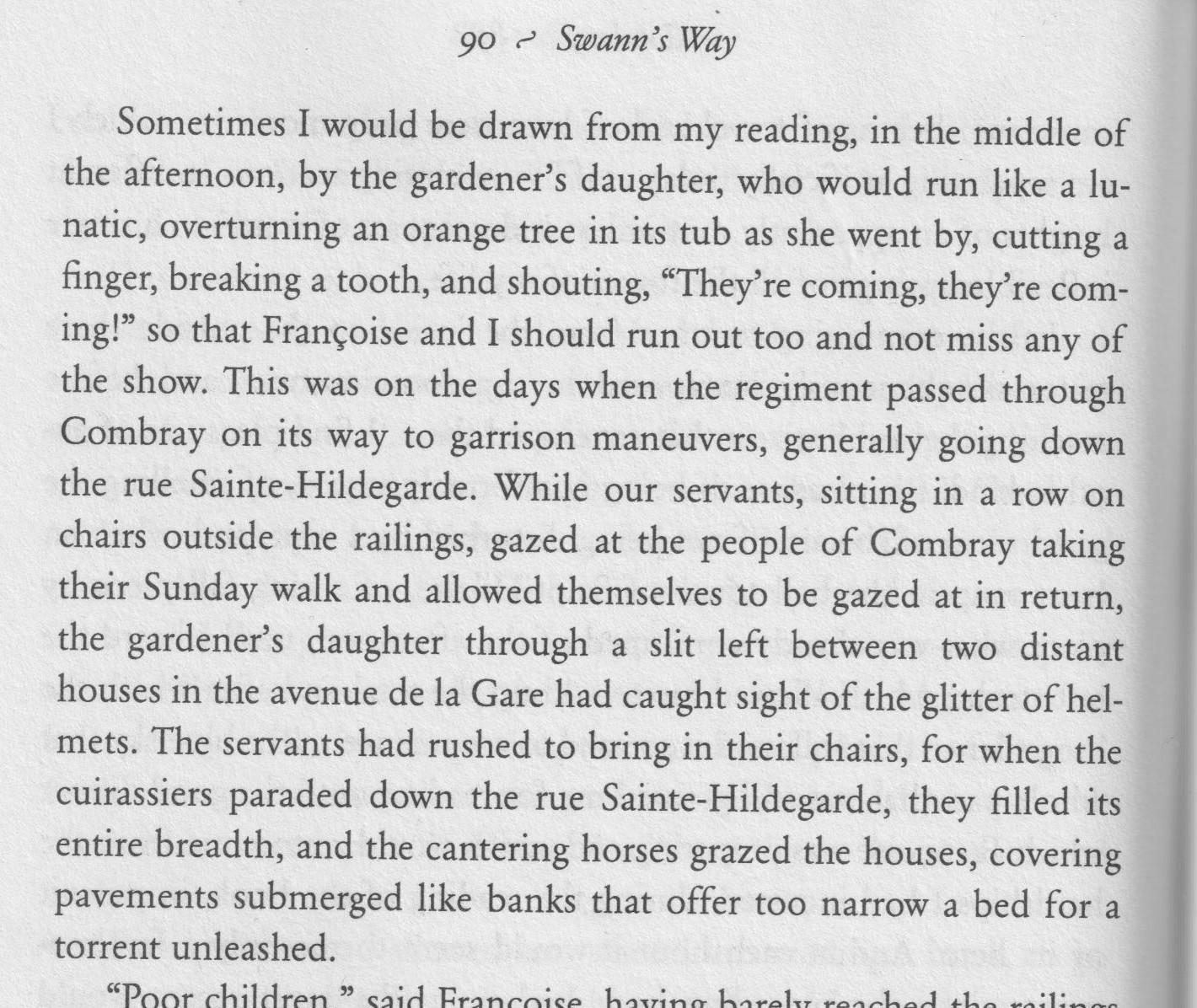
Sometimes I would be torn from my book, in the middle of the afternoon, by the gardener's daughter, who came running like a mad thing, overturning an orange-tree in its tub, cutting a finger, breaking a tooth, and screaming out "They're coming, they're coming!" so that Françoise and I should run too and not miss anything of the show. That was on days when the cavalry stationed in Combray went out for some military exercise, going as a rule by the Rue Sainte-Hildegarde. While our servants, sitting in a row on their chairs outside the garden railings, stared at the people of Combray taking their Sunday walks and were stared at in return, the gardener's daughter, through the gap which there was between two houses far away in the Avenue de la Gare, would have spied the glitter of helmets. The servants then hurried in with their chairs, for when the troopers filed through the Rue Sainte-Hildegarde they filled it from side to side, and their jostling horses scraped against the walls of the houses, covering and drowning the pavements like banks which present too narrow a channel to a river in flood.
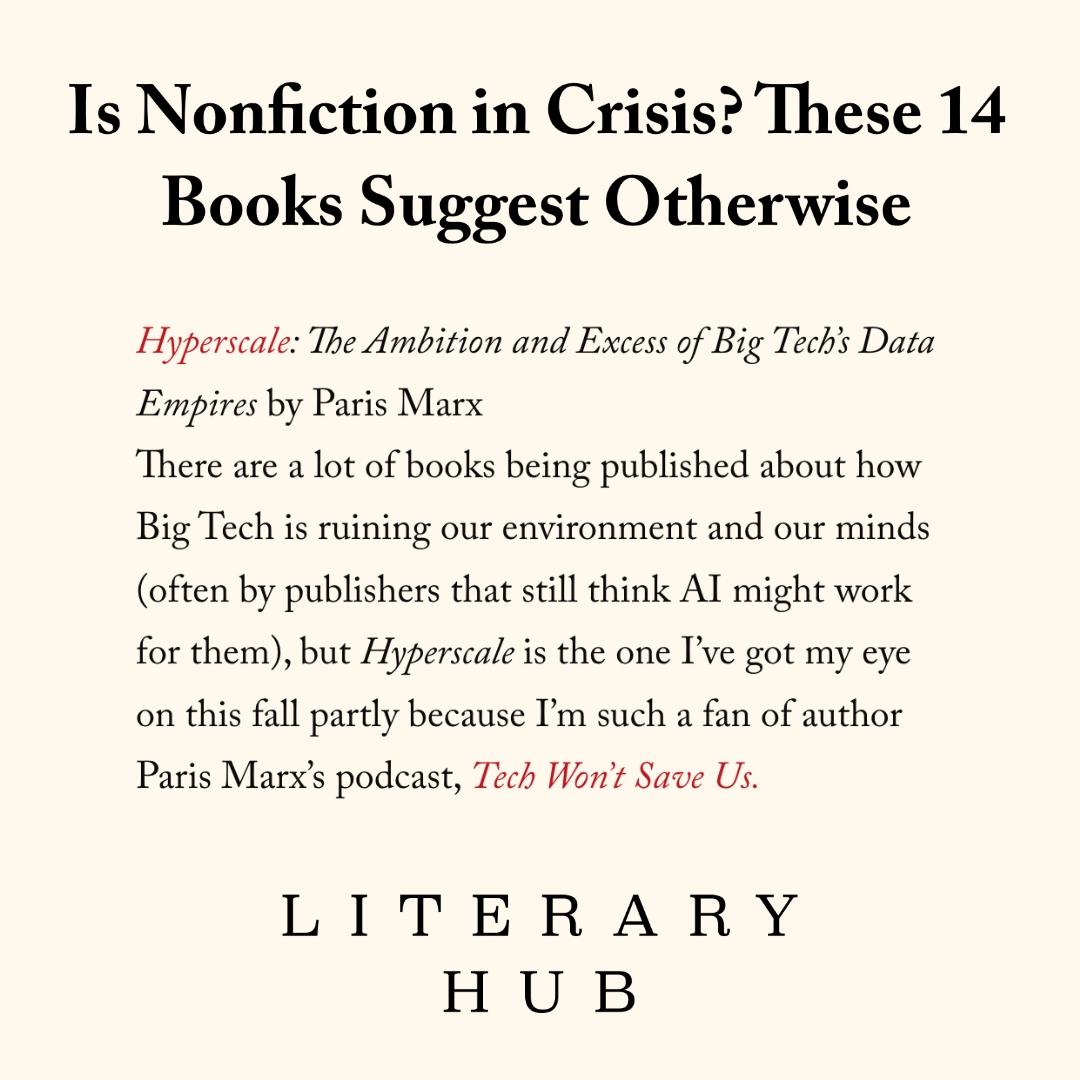
“There are a lot of books being published about how Big Tech is ruining our environment and our minds (often by publishers that still think AI might work for them), but Hyperscale is the one I’ve got my eye on this fall.”
@literaryhub recommends my new book HYPERSCALE on its non-fiction list!
Preorder your copy: https://hyperscalebook.com
#tech #reading #books #techbooks #datacenters #artificialintelligence
Alt...
Is Nonfiction in Crisis? These 14 Books Suggest Otherwise
Hyperscale: The Ambition and Excess of Big Tech's Data
Empires by Paris Marx
There are a lot of books being published about how Big Tech is ruining our environment and our minds (often by publishers that still think Al might work for them), but Hyperscale is the one I've got my eye on this fall partly because I'm such a fan of author Paris Marx's podcast, Tech Won't Save Us.

Alt...
Hyperscale is out October 20, 2026
![[?]](https://stockroom.wandering.shop/accounts/avatars/109/866/394/361/361/815/original/82fa3f21c8296c01.png)
Donald A. Wollheim (1914-1990) was born on this day. Bibliography: https://www.isfdb.org/cgi-bin/ea.cgi?826
L, Virgil Finlay, 1956; R, Cosimo Scianna, 1966
#scifi #sciencefiction #books

Alt...
Cover for One Against the Moon. Man in spacesuit drags another. They are on the moon. There's a rocket ship. Earth is in the distance.

Alt...
Cover for World's Best Science Fiction: 1966. Cover is a vaguely city-like construct. There are spheres, towers, etc.
![[?]](https://mstdn.archaeo.social/accounts/avatars/109/536/646/346/737/618/original/63eedbc70a21c2dc.png)
Talked to someone who has been dabbling in translating fiction. This guy was horrified when I told him that if he uses machine translation for more than dictionary checks of individual words, he can't put his name on the translation and the work is ineligible under most standard publishing contracts.
"OMG, but then it would take FOREVER to translate a novel!?!?"
Yes. You're right. That's why translators get paid.
![[?]](https://fedi.arkadi.one/fileserver/01SQBXAPQV74K8GJE30XNSHPQ9/attachment/original/01ZKENP5JVQT5AVP95K69YS610.png)
![[?]](https://media.beige.party/accounts/avatars/110/967/679/984/617/827/original/255cc56b093d79a6.png)
I like finding Audiobooks narrated by famous people. One of my favorite books, The Fireman is read by Kate Mulgrew. I loved Gareth David-Lloyd’s narration of The Call of Cthulhu. Now I’m eyeing Ann Patchett’s Tom Lake performed by Meryl Streep.
Anyone else have similar experiences with audiobooks? #books #audiobooks
![[?]](https://lazybear.social/system/accounts/avatars/000/000/001/original/3462887fef61ddb1.png)

#OverUnder 085 with @theresmiling.
She shares her thoughts about #Arduino, #Polaroids , #television, #StarTrek, and #eggs.
She also replied to @gabz about her everyday carry or just something she'd be lost without
And, we got two #books recommendations. YAAAY .
#bloggers #bookstodon #book #blog #fediverse #mastodon #blogging #tvshows #tv #photography
#100DaysToOffload 90/100
New column, rumination, and update: "What pre-1985 science fiction are you reading?" sciencefictionruminations.com/2026/09/27/w...
#scifi #sciencefiction #books

Alt...
A selection of read volumes from my shelves. For links to my reviews, see the post itself. From L to R: Stanislaw Lem’s Solaris (1960, trans. 1970) (cover is a large brai nand planets), Angela Carter’s Heroes & Villains (1969): (cover is a man and a woman in exotic robes and diaphanous dresses), saac Asimov’s Foundation (fix-up 1951) (cover is a man's upraised hand, a space person, and a face), Jack Vance’s The Languages of Pao (1958)
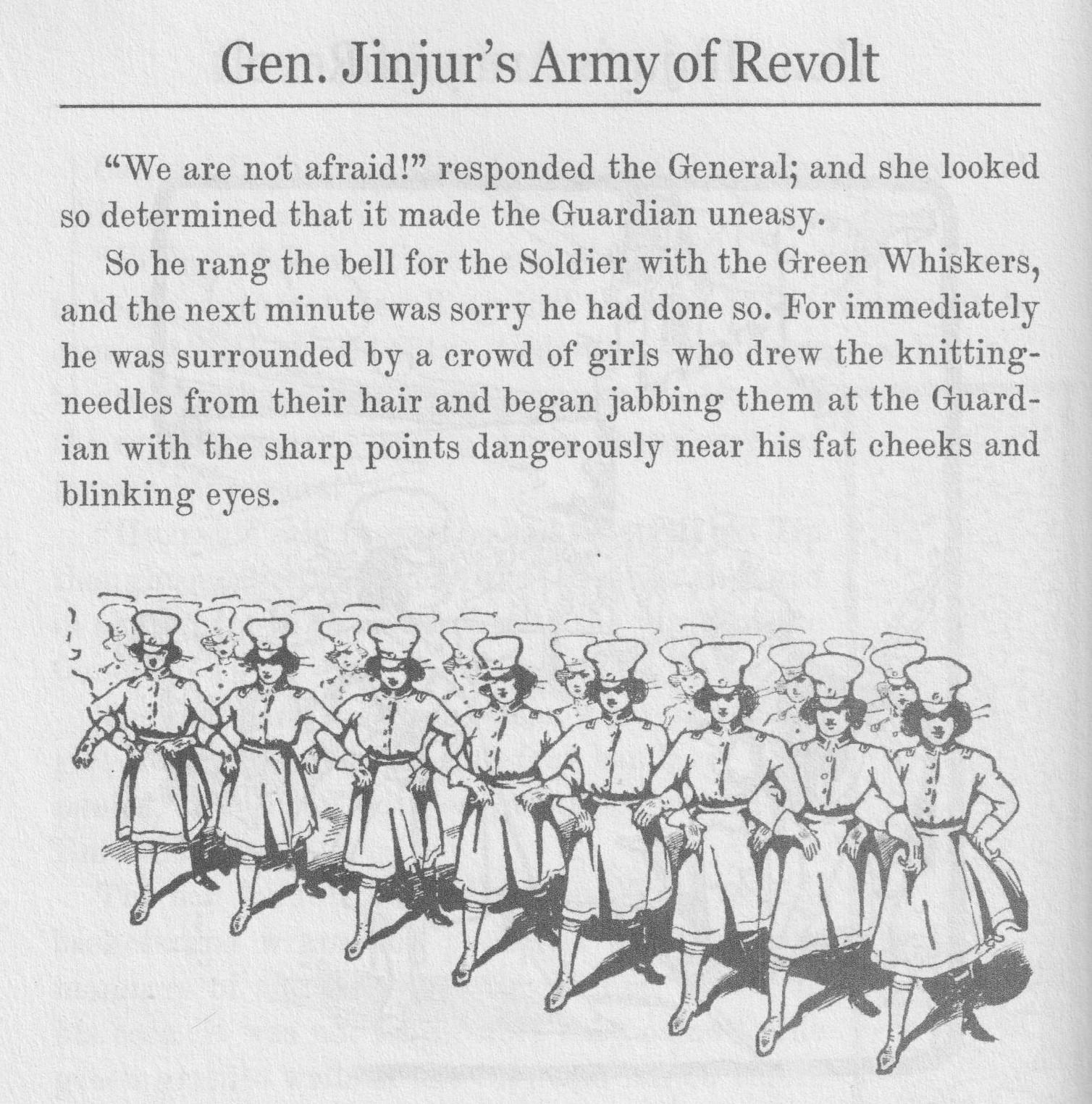
In the second Oz book (The Marvelous Land of Oz, 1904) a girl's army overthrows the Emerald City.
Alt...
"We are not afraid!" responded the General; and she looked so determined that it made the Guardian uneasy.
So he rang the bell for the Soldier with the Green Whiskers, and the next minute was sorry he had done so. For immediately he was surrounded by a crowd of girls who drew the knitting-needles from their hair and began Jabbing them at the Guardian with the sharp points dangerously near his fat cheeks and blinking eyes.
Fantastic haul from the bookstore today. Insanely cheap.
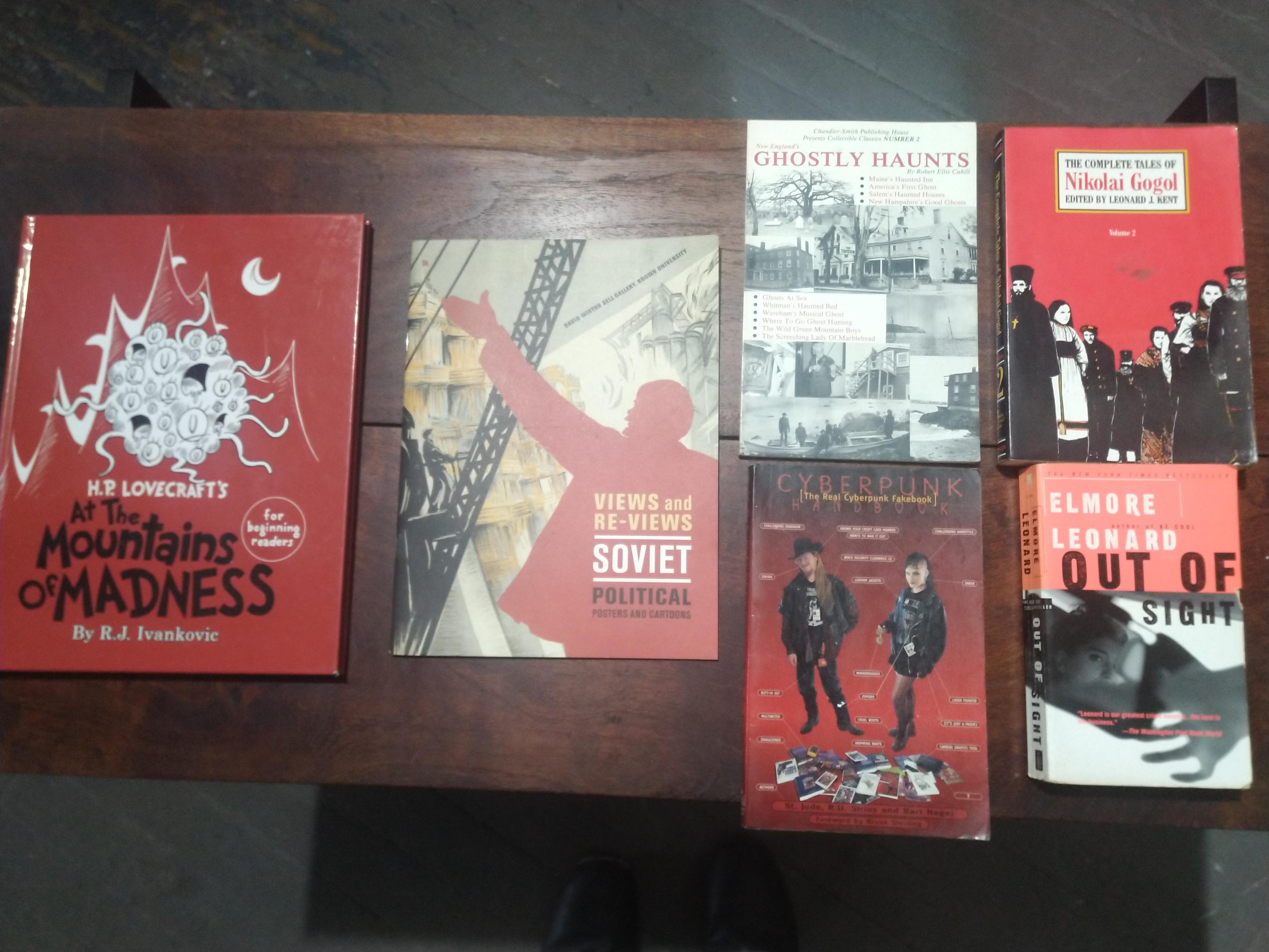
Alt...
Six books. A Dr Seuss style adaption of Lovecraft's At The Mountains of Madness, a collection of Soviet political posters, Ghostly Haunts, Cyberpunk Handbook, Gogol short stories, and Elmore Leonard - Out of Sight.
![[?]](https://media.mas.to/accounts/avatars/113/023/133/098/151/828/original/abf88a3736606ed7.png)
I’m an author and journalist writing about science and technology and media and information. My books include Chaos, The Information, and Time Travel, as well as biographies of Richard Feynman and Isaac Newton.
Coming November 10:
The Telephone—A New History
https://around.com/8170-2/
#Introduction #authors #science #chaos #books #information #timetravel #telephone
Want to make sense of the AI doom loop? The Guardian says you should should check out my forthcoming book HYPERSCALE.
“This is a deep investigation into the physical impact of AI data centers around the world.”
Preorder now: https://hyperscalebook.com
Check out the full list: https://www.theguardian.com/books/2026/sep/17/ai-doom-books-reading-list
#tech #ai #artificialintelligence #datacenters #reading #books #newbook

Alt...
Feeling overwhelmed by the AI doom loop? Here’s the essential reading list to make sense of it all
Hyperscale – Paris Marx
From the journalist and host of the Tech Won’t Save Us podcast, this is a deep investigation into the physical impact of AI data centers around the world, and the toll they are taking on local communities and the global environment.

Alt...
Hyperscale: The Ambition and Excess of Big Tech’s Data Empires. Coming October 20, 2026.
RE: https://mastodon.social/@robinince/117332620969156755
Thank you to everyone who is supporting the Patreon in any way - the main feature is Liberation Conversations but I try to put something interesting up most days #podcast #books #psychology
Today’s reading is from a book that inspired Derek Jarman - Beautiful Flowers and How to Grow Them - podcast available for free to anyone who signs up to Patreon
https://www.patreon.com/RobinInce/posts/beautiful-and-to-170551690 #beauty #flowers #gardening #books #lgbtq
Today’s reading is from a book that inspired Derek Jarman - Beautiful Flowers and How to Grow Them - podcast available for free to anyone who signs up to Patreon
https://www.patreon.com/RobinInce/posts/beautiful-and-to-170551690 #beauty #flowers #gardening #books #lgbtq
John Brunner (1934-1995) was born on this day. Bibliography: https://www.isfdb.org/cgi-bin/ea.cgi?11
L, Steele Savage, 1969; R, Murray Tinkelman, 1976
#scifi #sciencefiction #books

Alt...
Cover for The Stand on Zanzibar. Lots and lots of people in box-like apartments. It's trying to emphasize the overpopulation of the future that's central in the book

Alt...
Cover for The Sheep Look up. The outline of a human form arrayed against the dry desert. The man holds a sheep skull with dry flowers. He is wearing a gas mask.
Artist Jack Gaughan (1930-1985) was born on this day. Bibliography: https://www.isfdb.org/cgi-bin/ea.cgi?1805
L, 1965; R, 1967
#scifi #sciencefiction #books

Alt...
Cover for The Fellowship of the Ring. Gandalf standing on a crag with people behind him.

Alt...
Cover for Sleeping Planet. Some scary looking robots with tentacles and grasping claws surrounded by rockets and others shooting at them.

 🇲🇽 boosted
![[?]](https://polymaths.social/fileserver/013RN8NXA0747YAHNF3Q0WVKE7/attachment/original/01KNF997P108S68XZSYR1TEW47.png)

I put up some more Science Gossip last night . Tonight, I think a little of Women of the London Underworld
https://www.patreon.com/RobinInce/posts/of-glow-worms-170288539 #crime #pulp #books #science
Liberation Conversations is here - episode one - Hollie McNish - I hope you think we are worth supporting https://www.patreon.com/RobinInce/posts/liberation-1-170240402 #poetry #podcast #feminism #creativity #writing #books
I will be at The Heath Bookshoo between two and four pm tomorrow if you want help with browsing , a poem or a conversation #bookshop #books #poetry #neurodiversity #adhd #conversation